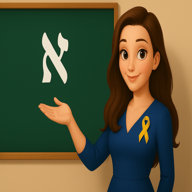
Learn the Hebrew Alphabet (Aleph Bet)
All 22 Hebrew letters with names, pronunciation, and example words. The complete guide for children learning to read Hebrew.
Practice with Games – FreeThe 22 Hebrew Letters (Aleph Bet)
Hebrew is read right to left. Each letter has a name and a sound.
The Hebrew alphabet — the Aleph Bet — has 22 letters, and every one of them is a consonant. That single fact explains most of what feels unfamiliar to an English-speaking family at the start. There are no vowel letters in the way English has A, E, I, O and U. Vowel sounds are carried instead by Nikud: small dots and dashes written underneath, inside, or above the letters. Children's books, prayer books, and beginning school texts all include those marks, which is why a child who learns letters plus Nikud can read almost any book written for their age.
Five of the 22 letters change shape when they land at the end of a word: כ becomes ך, מ becomes ם, נ becomes ן, פ becomes ף, and צ becomes ץ. These are called final forms, or sofit letters. They make no new sound — they are simply how the letter is written in that position — so most children pick them up quickly once they have met the regular form first.
A few letters are worth flagging early because they trip up new readers. Aleph (א) and Ayin (ע) are silent on their own and take whatever vowel sits beneath them. Bet (ב), Kaf (כ) and Pe (פ) each have two sounds depending on whether they carry a dot in the middle: B/V, K/KH, and P/F. And several pairs sound identical in modern Hebrew — Tet (ט) and Tav (ת) both say T, Kaf (כ) and Kuf (ק) both say K, Samech (ס) and Sin (שׂ) both say S — which matters for spelling later, but not for reading now.
Tap any letter below to open its own guide, with the letter's sound, how it is written, the words children usually meet it in first, and a short practice list.
Hebrew Alphabet Pronunciation & Phonics
Understanding the basics makes learning much easier for children.
Hebrew is Read Right to Left
Unlike English, Hebrew text flows from right to left. Children need to practice this direction early, which is why games and interactive practice are so effective.
Vowels (Nikud)
Hebrew uses small dots and lines beneath and above letters to show vowel sounds. Children's books and beginner texts include these marks to help new readers.
5 Letters with Final Forms
Five Hebrew letters change shape when they appear at the end of a word: כ→ך, מ→ם, נ→ן, פ→ף, צ→ץ. Beginners learn both forms.
Aleph Bet Songs
Singing the alphabet is one of the most effective ways young children memorize letter names and sequence. Kriakala incorporates audio and rhythm into every lesson.
Learning Steps for Kids Ages 4–7
A structured path from letters to full reading.
Step 1 – Letter Recognition
- Learn each letter's shape and name
- Match uppercase/printed forms
- Practice identifying letters in words
Step 2 – Letter Sounds
- Connect each letter to its sound
- Practice pronunciation with audio
- Learn which letters share sounds (ב/ו, כ/ח)
Step 3 – Syllables & Words
- Combine consonants with vowels
- Read simple 2–3 letter words
- Build reading confidence with games
Practice the Aleph Bet with Fun Games
Kriakala's interactive games make Hebrew alphabet practice feel like play.
Download Kriakala Free